Map the Fanout Queries AI fires at the web
*You'll need to bring your own API keys. We're not that generous!
Monitors all major AI platforms
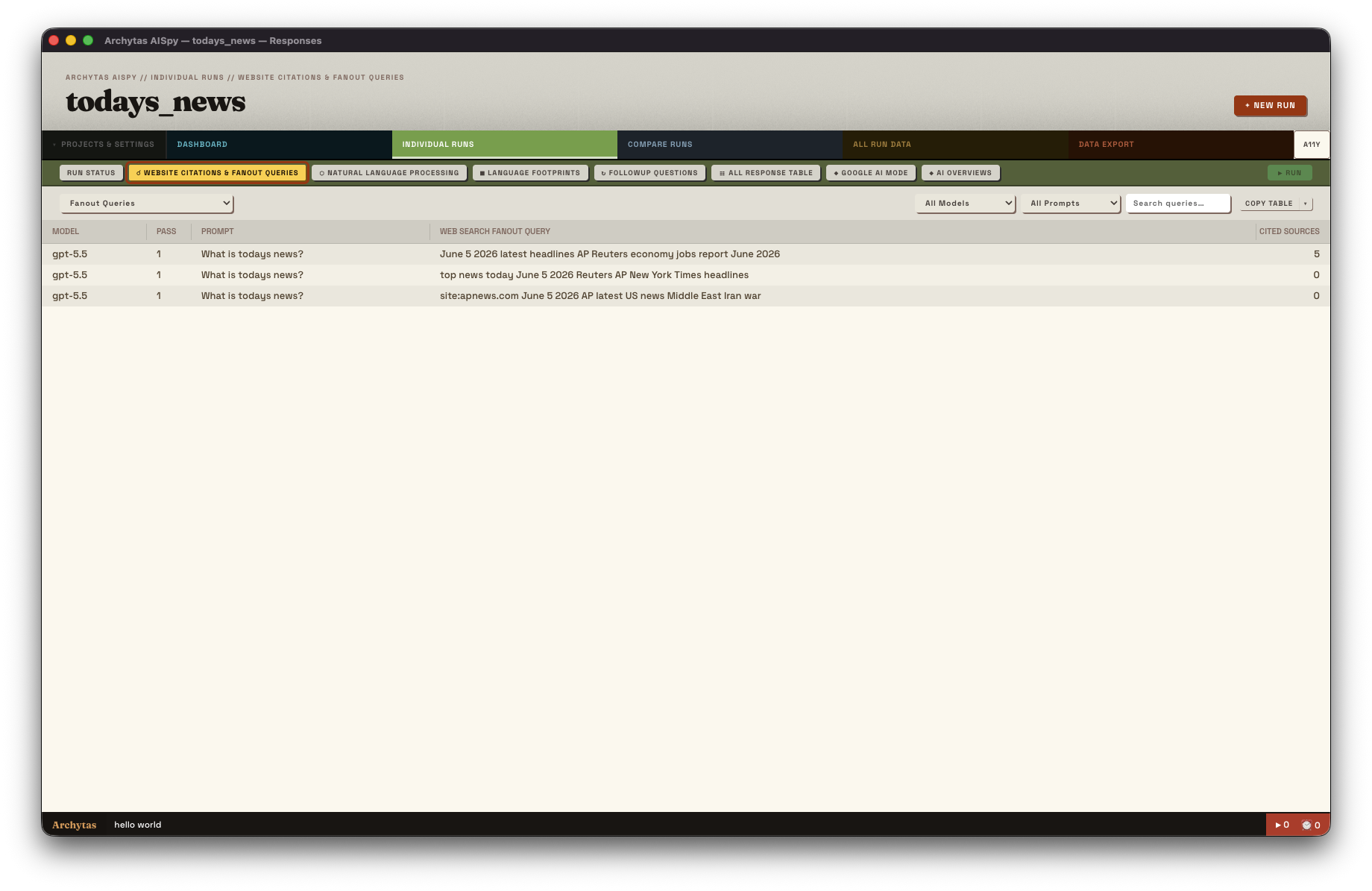
When a user asks an LLM a question, the model often fires a set of web searches before generating a response. Archytas AISpy surfaces those queries for each of your tracked prompts - giving you a direct view of the search terms driving what each model says about your topic.
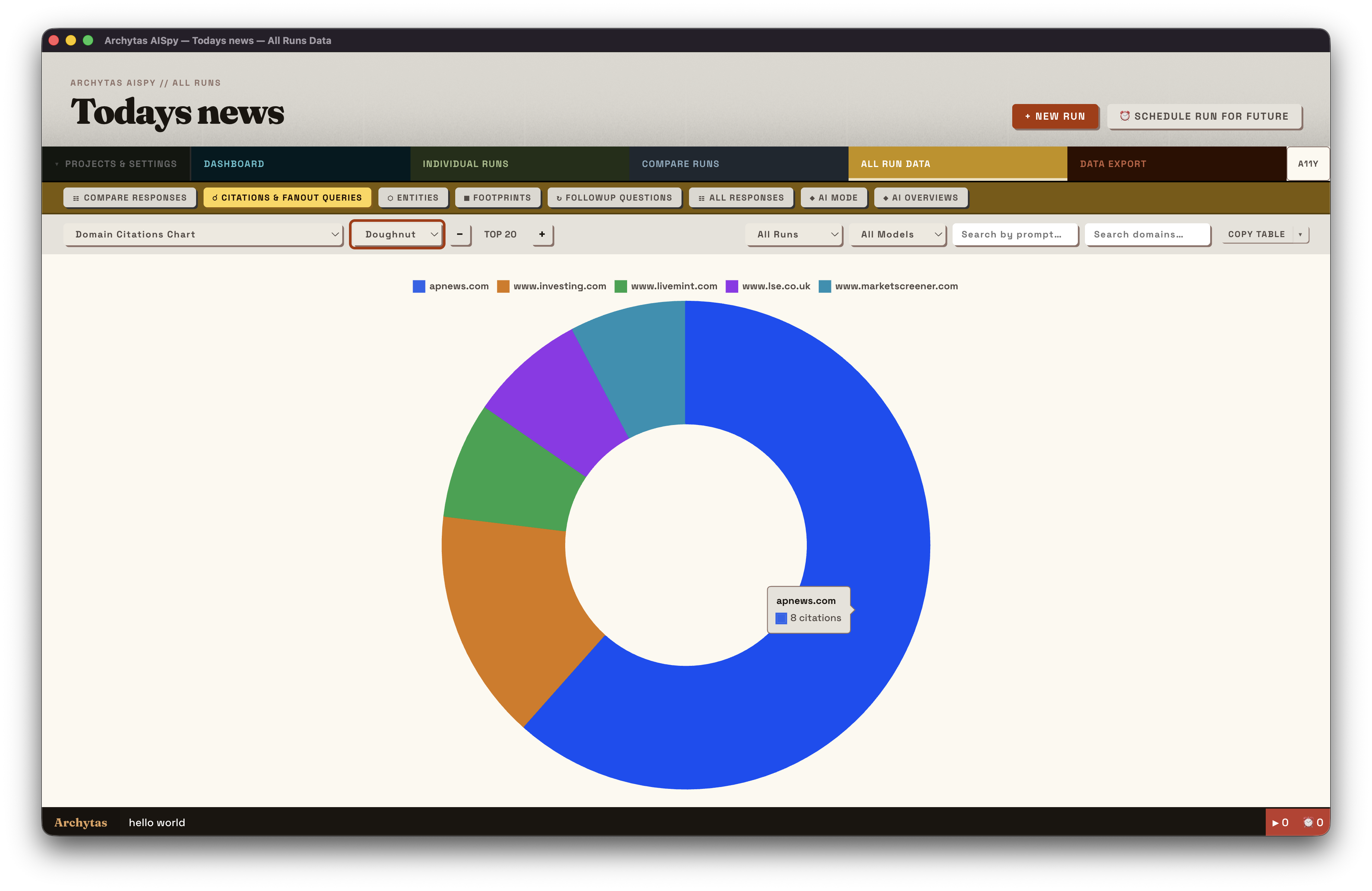
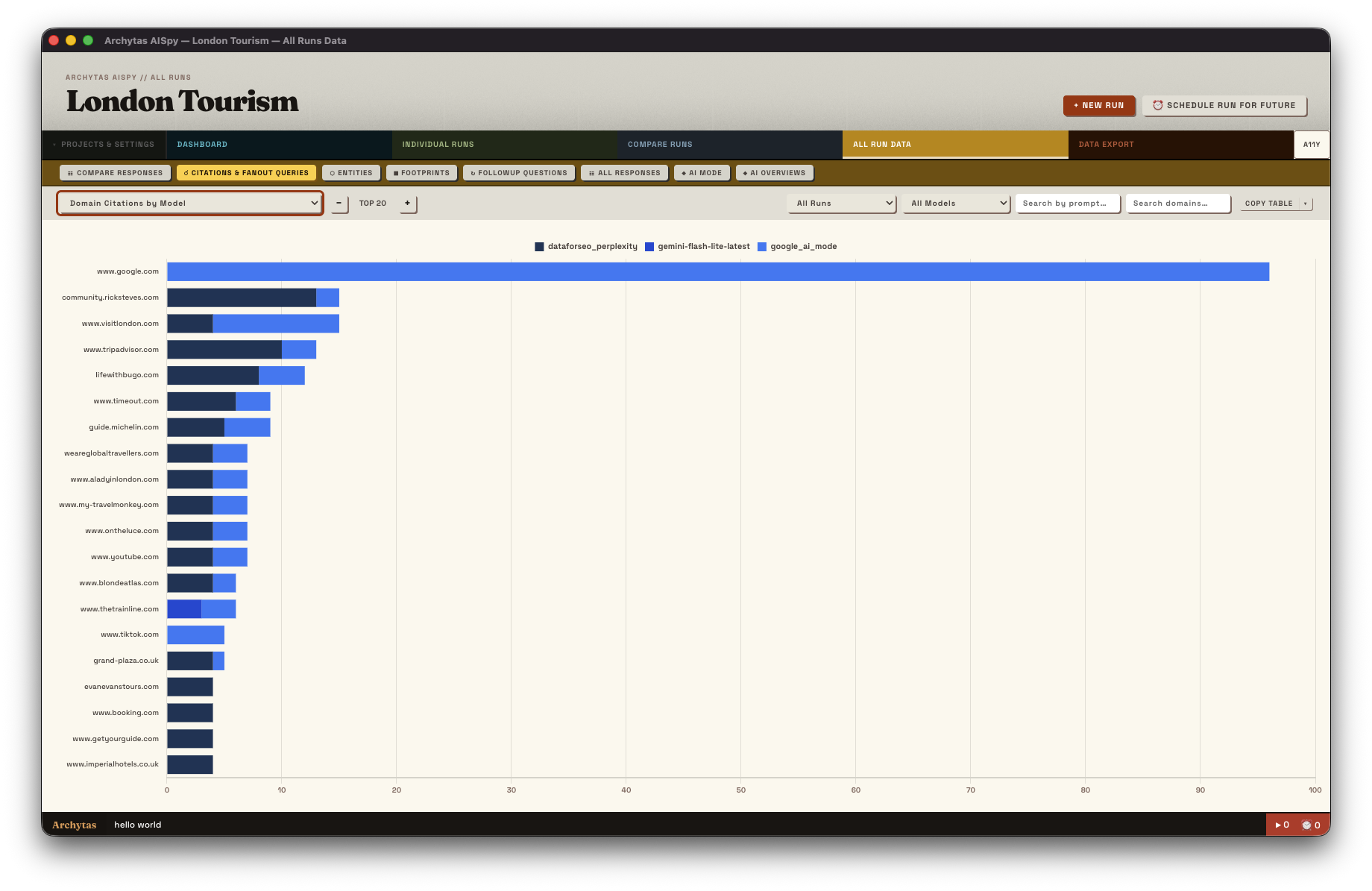
Map the URLs LLMs are citing for each query fanout. See which domains are consistently trusted for your topic area, who is getting cited across multiple models, and understand the competitive landscape around your audience.
Query fanouts are a map of what AI thinks is the need behind the user's ask. Use the fanout query map to inform your own content strategy, identifying the specific questions and topics your content needs to address to earn that citation.
AI Fanout Query Analysis and Monitoring on Mac, PC and Linux
Guide content creation by reviewing the full set of web searches each LLM fires behind the scenes.
For every search query the LLM fires, see which domains appear in the results it uses for its response.
Compare ChatGPTs citations across OpenAIs models, and compare to other providers.
When an LLM with web access (like ChatGPT, or Gemini) receives a prompt, it often generates a set of web search queries before composing its response. These are the web fanout queries - the model's interpretation of what it needs to look up in order to answer well. Mapping those queries shows you the search terms that are actually driving AI-generated content in your topic area, so you can craft appropriate content.
LLMs are making those queries for a reason - they think they will answer the users need. By comparing your own content against those queries, you can reveal gaps in your own content experience. And, by measuring who else is visible for those fanout queries, you can identify potential social, PR and influencer outreach plans that will further re-enforce the messaging you want AI to pick up on.
Not all, and not always. Models with web search enabled (like Perplexity, which always searches, or ChatGPT with browsing turned on) produce fanout queries consistently. Models like Claude may or may not search depending on the version and whether web access is enabled. Archytas AISpy captures fanout queries where they're available and flags the model and configuration when they're not.
Traditional keyword research tells you what people type into search engines. Fanout query mapping tells you what queries AI models search for on those people's behalf. There's similarities, but LLMs often reframe questions before searching, use more specific or technical phrasings, and draw from a different set of content types than organic search rankings would suggest.
That's precisely what it's designed for. If you can see that LLMs are firing a specific query when someone asks about your space-and your content doesn't address that query-you have a clear gap to fill. It's keyword research for the AI era: the queries that actually drive citation decisions.
It depends on your objective. For content strategy, model updates can significantly affect the types of queries AI makes, so it is worth periodically refreshing the analysis for new models. For more outreach-driven strategies, the landscape changes more frequently depending on the traditional search results.
An early weakness of LLMs was their cutoff date - they were unaware of anything that happened after the date they were trained. To solve this, LLMs now often search the web just as a user would, compiling up to date information to include in their response. AISpy tracks where these 'fanout searches' happen, what queries they searched, and who was cited in the response.
Some, and it varies not just by LLM, but by individual model and the sort of account the user has. A paid subscription user is more likely to trigger more fanout searches than a free, logged out user. It costs AI companies more money to respond with fanout query data, so they are constantly trying to calibrate when they should and shouldn't trigger searches. One of the use cases for AISpy is to track where they're triggering searches over time, so you can see how this is evolving in your area.
Yes. Fanout queries tend to be different from how users search - loading them into your SEO rank tracker of choice is a great way to measure where your website is in the running to compete for a citation.